Imagine a kid in a classroom who raises a hand to ask a question, and the whole room laughs. It lasts maybe five seconds. The teacher moves on, the lesson continues, and by any outside measure nothing happened. But inside that kid, something tightened and shut down, and it never quite got the message that the moment was over. Thirty years later, that same person is a capable adult who goes quiet in meetings and cannot explain why. That, in a very ordinary form, is what I mean by somatic trauma.
Most of us have an image of trauma that involves something enormous and obvious. That image is part of why so many high-functioning people never think the word applies to them. This post is about a different way of looking at it, one that is more accurate, less dramatic, and a lot more useful if you are someone who has done everything right and still feels something running in the background.
Trauma is not the thing that happened
The common assumption is that trauma is the event itself: the accident, the loss, the frightening year, the difficult home. Those events matter, and some of them carry a very high potential to leave a mark. But the event is not the trauma.
Trauma is what happens inside a person in response to the event. The proof is simple. If the event were the trauma, the stress would end the moment the event ended. The laughing stops, the threat leaves, and the body returns to calm. In real life that does not always happen. Two people can go through the same experience and come out of it very differently, because what matters is whether the nervous system was able to complete its response.
That is why I find it more useful to ask a different question. Not “what is wrong with you?” but “what happened, and what did your body have to do to get through it?” The first question starts with a verdict. The second starts with a mechanism.
What happens inside: the loop that never closes
When something overwhelms us, the nervous system goes into a survival response. You may know the names: fight, flight, freeze, and for some people, fawn. Adrenaline and cortisol flood the system, and sometimes shame, fear, or anger rides along with them.
In a healthy sequence, the response runs its course. The threat passes, the body discharges what it mobilized, and you come back to a calm baseline. Peter Levine, one of the pioneers of somatic work, describes this as a loop that is supposed to open, run, and close.
The problem is what happens when it cannot close. Maybe we were young and there was no steady adult to help us settle. Maybe the pressure simply never let up. The stress response does not finish, so the body holds onto the charge. You can calm down a little on the surface, but there is a hum in the background that never fully goes away. That unfinished response is what I call stored survival stress, and it is what I mean when I talk about somatic trauma.
Another way to say it is that some life experiences go undigested. When an experience arrives and we do not yet have the capacity or the resources to process it, it stays active in the system, waiting to be finished.
An adaptation, not a defect
Here is the part I most want you to take from this. What your nervous system did was intelligent. It adapted to the conditions it was in, and that adaptation helped you get through them. Going quiet, staying on guard, and staying busy were all strategies that worked at the time.
The trouble comes years later, when the conditions have changed and the adaptation has not. The body is still running a plan built for an earlier situation. That is not a defect in you, and it is not a life sentence. I am not a clinician, and I am not talking about diagnoses here. I am talking about a pattern that was learned, which means it can also be unlearned. Human beings are remarkably good at re-adapting when the stored stress is actually released and the body is given a way to feel safe again.
It is a spectrum, not a switch
We like clean categories: you either have anxiety or you do not, you either have trauma or you do not. It does not work that way. Everyone carries some of this, because it is part of being a person, and each of us sits somewhere on a spectrum.
At the lighter end, it looks like the kid in the classroom: one contraction that never got resolved. At the heavier end, many of those contractions add up, and the body is holding a great deal. The further along the spectrum, the more overt the symptoms tend to be. But the mechanism is the same all the way along, and that is the reassuring part. It is not a different kind of person. It is the same system under different amounts of load.
Think of it like a brick wall with a garden behind it. From the front, all you see is the tops of the branches sticking up over the wall: the habits, the reactions, the thoughts that you cannot seem to stop. Those are the visible part. What is driving them is the root system on the other side of the wall, which you cannot see until someone takes a few bricks out.
How the stress turns into a pattern
When the loop does not close, a few other things tend to follow, and they explain why so many of us feel like we keep running into the same thing.
Stories form. The mind tries to make sense of the experience, and it often lands on a belief: the world is not safe, I am not good enough, no one will really show up for me. Those beliefs can be so deeply set that someone can carry the same one for sixty years.
Parts of us get pushed away. When an emotion is too big to feel in the moment, we distance ourselves from it. It becomes something like an orphaned part of us, set off to the side where we can keep an eye on it. We do that to avoid feeling the pain, and to make sure we see the next one coming. The cost is that we end up scanning for danger much of the time, often without realizing it.
Triggers appear. Something in the present, a look on a partner’s face or the tone of a boss’s email, resembles the original moment closely enough that the body responds as if it were happening again. The old state surfaces and takes over, often before the thinking mind has a chance to weigh in.
Patterns repeat. Because that part was never given the capacity to be felt and finished, it keeps coming back up in similar situations. That is why you can understand a pattern perfectly and still find yourself in it again.
Why this sounds like woo, and why it is not
I was a skeptic. I came from engineering, where you want a mechanism before you believe anything. So here is the plain version. There is no mysticism in any of this. There is no belief required. The model is simple: a stress response that did not complete is still running, and it is stored in the body. You can test whether that is true for you by noticing what happens in your own body when an old pattern is triggered.
I trained under Dr. John Amaral, and the principle that has stayed with me is that you do not fix this by trying harder. You remove what is in the way.
What actually helps
If the stress is stored in the body, then the work has to include the body. Thinking differently and talking it through can be valuable, and I would never tell you to stop. But for many people, those approaches alone do not reach the level where the stress is held. The stored charge has to be released, so the response can finish and the system can settle back into safe.
When that happens, the changes tend to feel less like effort and more like relief. Reactions that used to run the show lose some of their grip, and you stop having to manage yourself so carefully. Everyone’s experience is different, and I cannot promise any particular outcome, but that is the direction I see it go.
If you would like to see how this connects to the broader picture of stress and the nervous system, I wrote about it in Why Your Nervous System Gets Stuck in Survival Mode, and What Actually Rewires It.
Common questions
- Does this mean something terrible has to have happened to me? No. For many people, the cause is a series of small, ordinary moments that never got resolved, like the classroom example. You do not need a dramatic event for your nervous system to have held onto stress.
- Is this the same as therapy? It is not. Talk therapy works through story and thought, and it can be a real help. This work happens at the level of the body and the nervous system, and it does not ask you to relive or even explain your past in detail.
- Is this a diagnosis or a treatment? No. I do not diagnose, treat, or cure anything, and I cannot promise outcomes. This is educational, and it describes a way of looking at stress that many people find useful.
Two ways to work with this
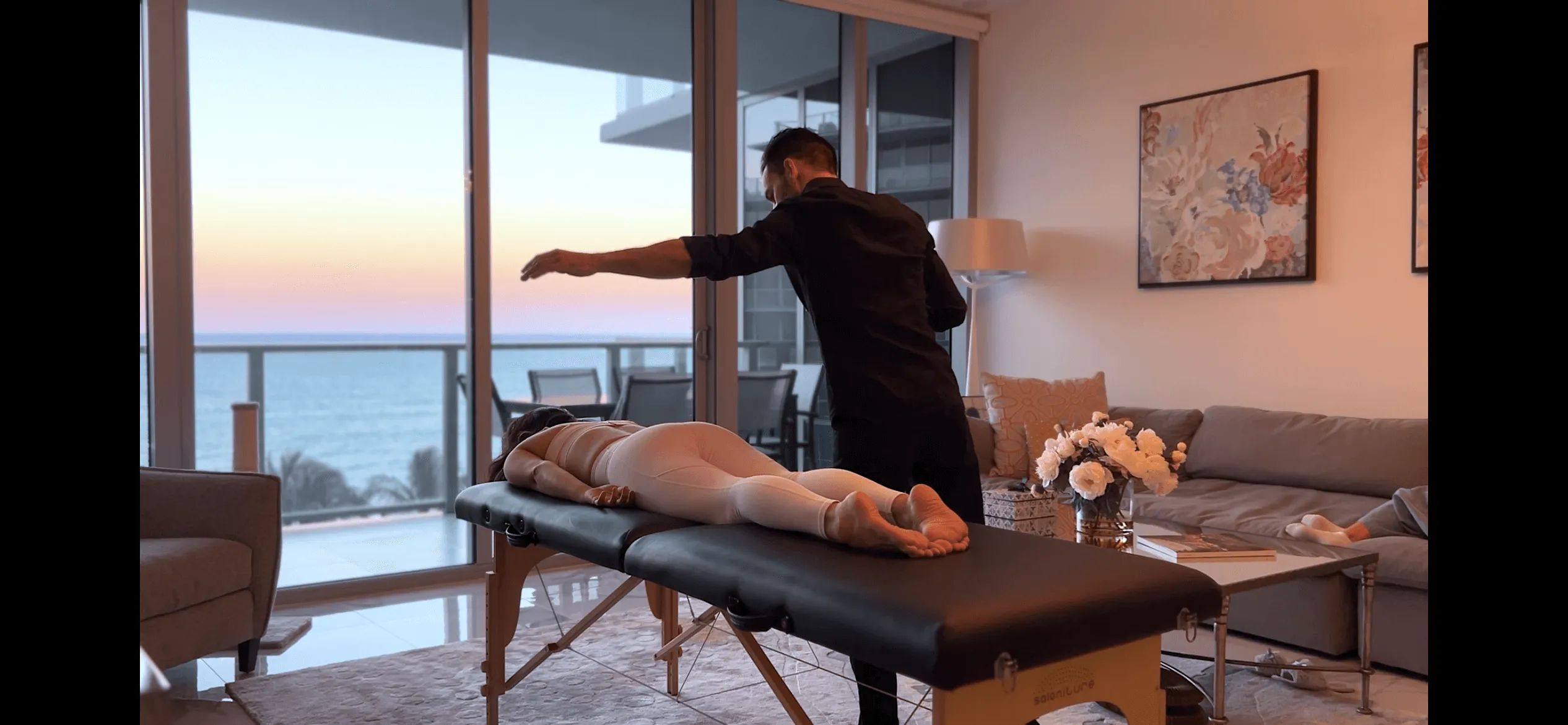
Stress can be undone, and there are two ways to start. If you want something you can do daily on your own, Mindworx is a self-guided way to undo the mental noise at the root. If you would rather have it done for you in person, Table Work is a hands-on somatic energy session here in Orange County.
Because lighter people build a better world.